Economy
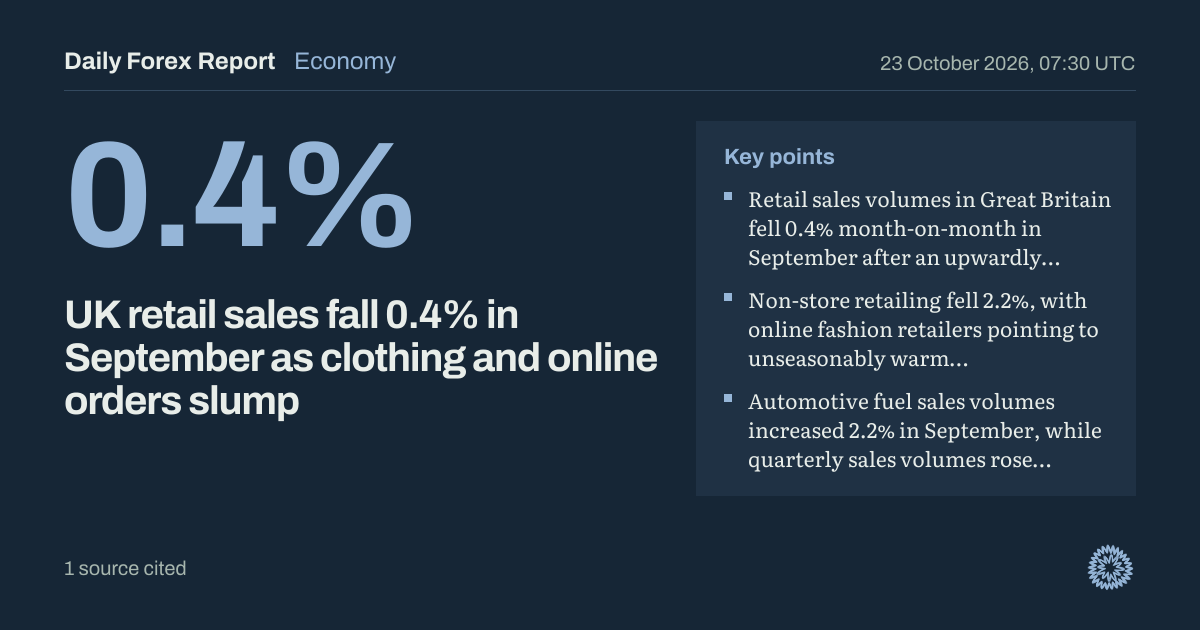
UK retail sales fall 0.4% in September as clothing and online orders slump
Retail sales volumes in Great Britain fell 0.4% in September, ONS data show, with online fashion declining while fuel spending rose on higher pump prices.
Key points
- Retail sales volumes in Great Britain fell 0.4% month-on-month in September after an upwardly revised 0.7% rise in August.
- Non-store retailing fell 2.2%, with online fashion retailers pointing to unseasonably warm weather.
- Automotive fuel sales volumes increased 2.2% in September, while quarterly sales volumes rose 0.7%.
Retail sales volumes in Great Britain fell by 0.4 percent in September, the Office for National Statistics reported on Friday, October 23. The contraction followed an upwardly revised 0.7 percent gain in August. Over the year to September, retail sales volumes rose 0.9 percent.
Online and department store sales led the monthly downturn. Non-store retailing, which is predominantly made up of online retailers, fell by 2.2 percent in September, marking its largest monthly decline since early 2026. Clothing and footwear stores also registered drop-offs, with fashion retailers noting that unseasonably warm autumn weather reduced demand for newly stocked cold-weather apparel.
Supermarket and food store sales volumes slipped by 0.4 percent over the month, retreating after higher sales during the late summer months. In contrast, automotive fuel sales volumes rose by 2.2 percent in September, recovering from previous weakness even as pump prices continued to trend higher across the country.
Looking across the wider quarter, retail sales volumes rose by 0.7 percent in the three months to September compared with the previous three months, supported by stronger consumer spending earlier in the summer. Compared with the pre-pandemic levels of February 2020, total retail sales volumes remained 0.8 percent lower, ONS data show.
The retail sales report arrives as the Bank of England assesses the resilience of domestic demand ahead of its November monetary policy decision. Consumer confidence measures have dipped in recent weeks as households prepare for the government's autumn Budget, making retail spending figures a key signal for currency markets and policymakers.